Roll one new rule across every file you ever wrote.
It tests the rule on your best work first, so a bad check never rewrites a good post. Mechanical edits come with proof that no sentence changed.
Built by Atharva Shah. Corpus Rule Rollout costs $19, paid once. Buy Corpus Rule Rollout. The skill folder and setup guide arrive by email.
Corpus Rule Rollout at a glance
Corpus Rule Rollout is an AI agent skill for Claude Code, Codex CLI, Gemini CLI, and other agents that read SKILL.md. Applies one new writing rule across hundreds of files without losing a sentence. Best for: content linting.
- Works with
- Claude Code, Codex CLI, Gemini CLI, Cursor, GitHub Copilot
- Category
- Writing and voice
- Price
- $19, one payment
- Requirements
- Needs a paid Claude plan with Claude Code and Python. Large judgement rewrites run many agents at once, so a higher Claude plan finishes faster. Your publish pipeline must have a dry run or a verify step for the pre-flight check.
- Included
- Calibration method, Whitespace-only edit guard, Pre-flight content check, Diagnose then rewrite fan-out
What Corpus Rule Rollout produces
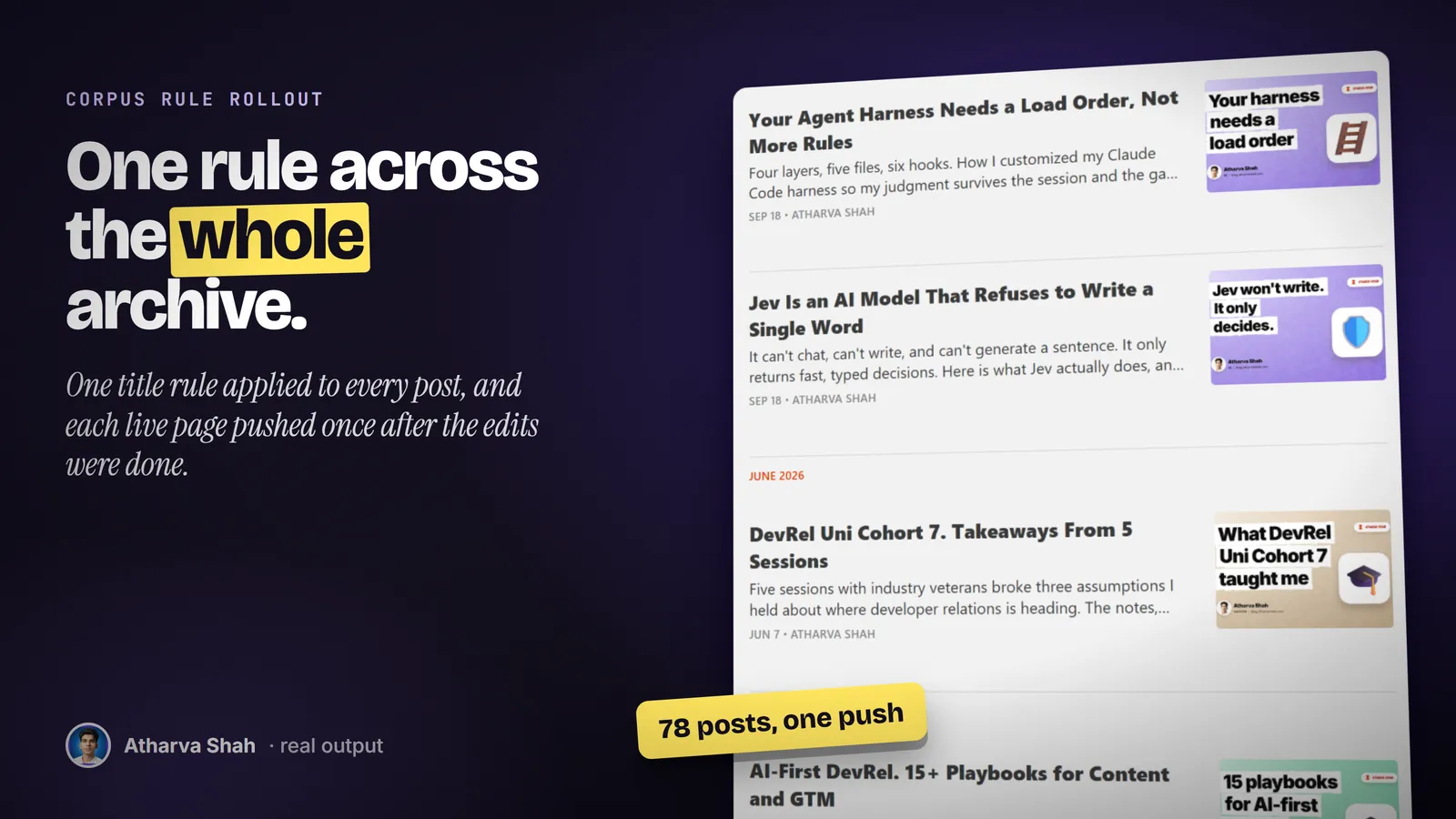
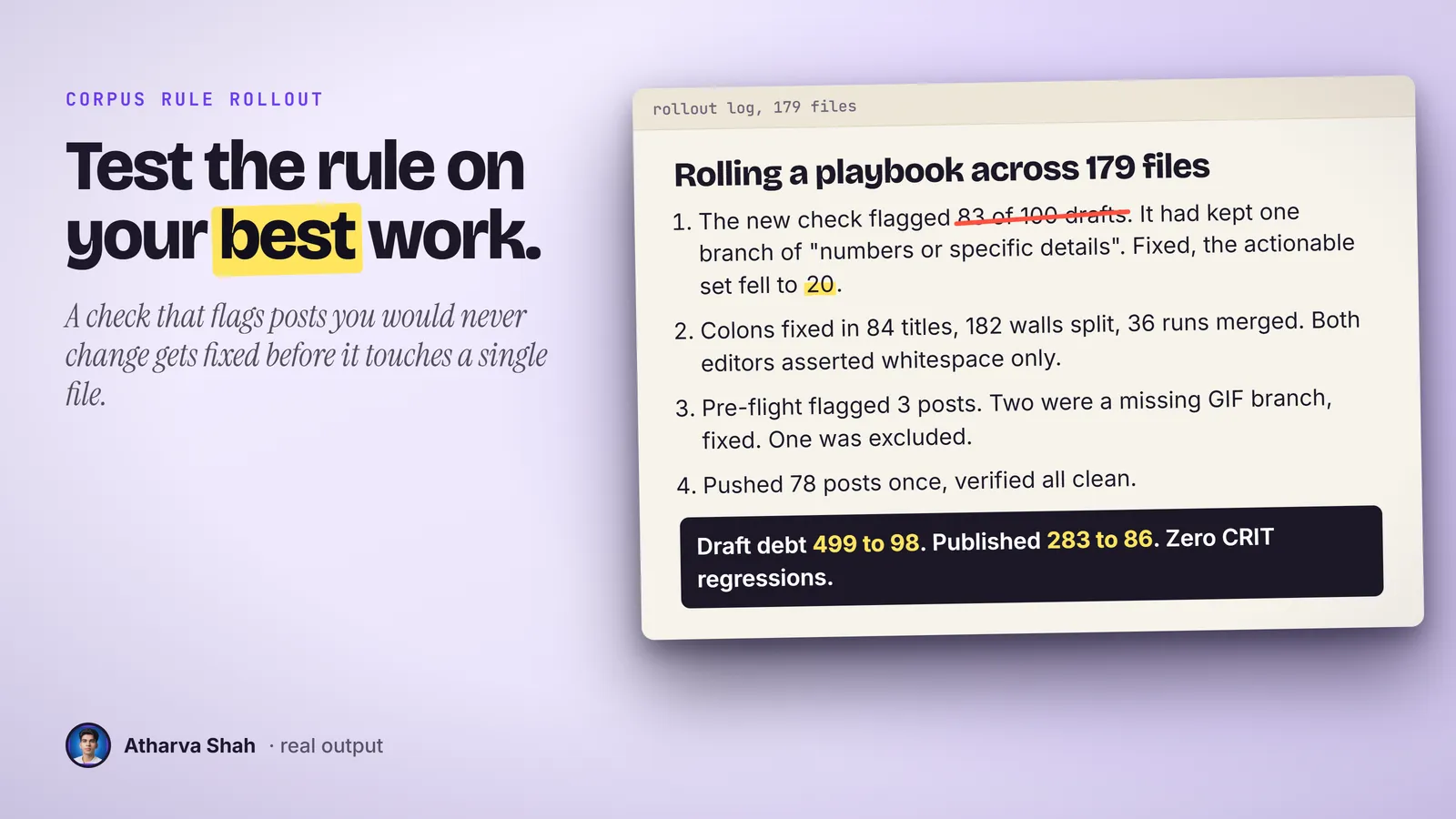
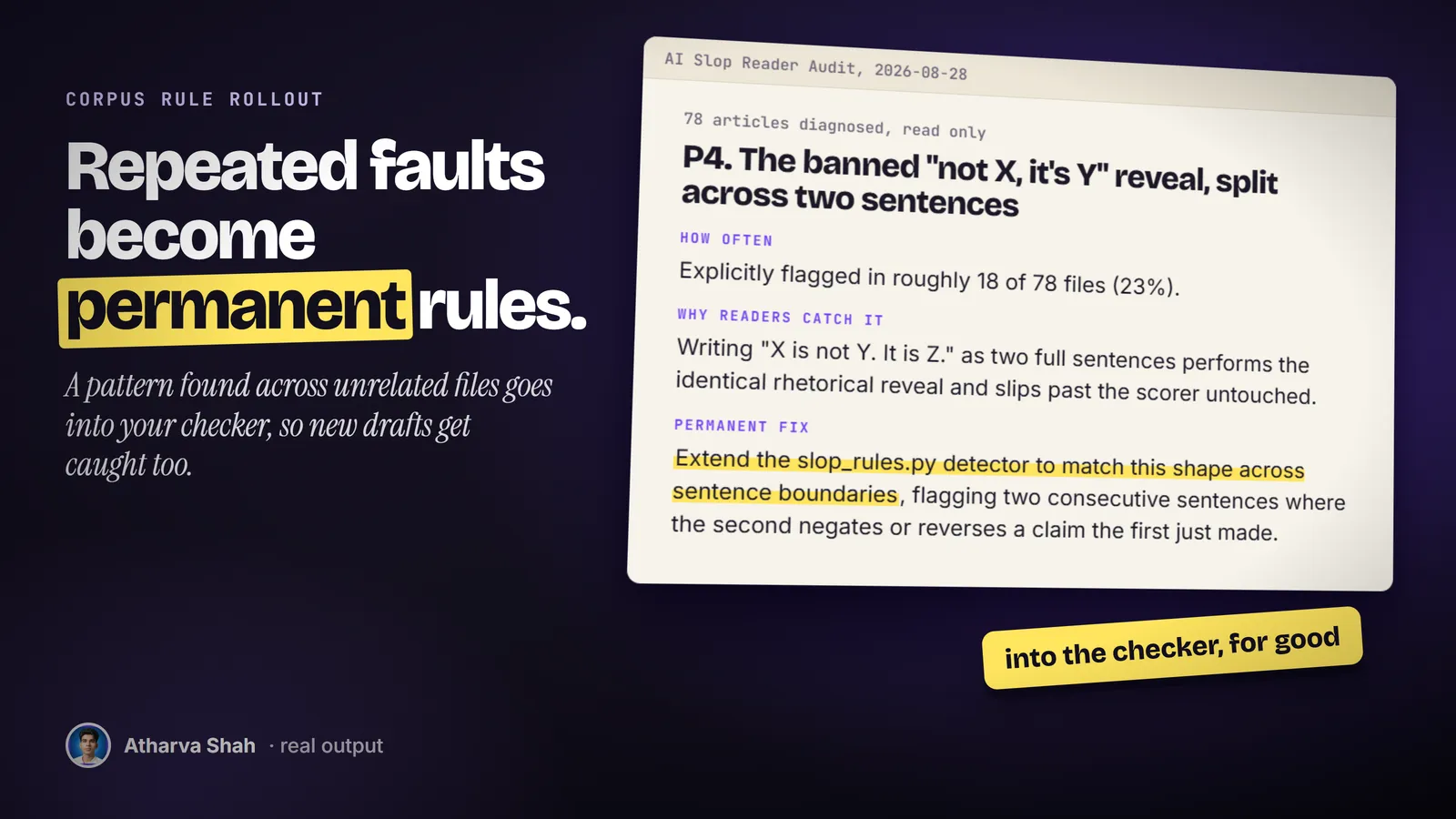
Apply the rule everywhere without breaking the archive.
You bring the rule and the folder. It handles the three places a bulk change goes wrong.
- Test the check on your best work. It runs the check and reads what it flags among files you already trust. When good work gets flagged, it fixes the check before it touches any file.
- Edit with proof. Mechanical fixes run as a dry run across the whole folder. The count of files with any word change must be zero before anything gets written.
- Publish once. It reads your publish pipeline for steps that drop content, holds back the files at risk, and pushes the rest in a single pass.
Bulk edits fail in the quiet places.
Find-and-replace breaks formatting. A bulk AI rewrite changes sentences nobody reviewed. This skill proves what changed.
Corpus Rule Rollout
- Calibrates first. Your best work tests the rule before the rule touches it.
- Whitespace-only proof. Mechanical edits must show zero word changes.
- No invented facts. Judgement rewrites mark a missing fact for you to fill.
- One publish pass. Every edit lands before the first push.
Bulk AI rewrite
- Unreviewed sentences. The model smooths lines you never asked it to touch.
- Invented facts. A rewrite can add a number or a quote that never happened.
- Trusts the rule. A half-built check gets applied to every file.
- No proof. You find the damage after readers do.
File by file by hand
- Weeks of work. Two hundred files is a month of evenings.
- Drift. The rule reads differently to you on file 150.
- Pushed twice. Titles one week and bodies the next rewrite every live page again.
- Missed files. Nothing tells you which ones you skipped.
It follows your rules and grows your checker.
When a problem needs judgement, it diagnoses every file read-only, then finds the patterns that repeat across unrelated files. A pattern that repeats goes into your own checker, so future drafts get caught automatically. Only then does it rewrite, worst file first, with each file carrying its own diagnosis.
Questions about Corpus Rule Rollout
What is content linting?
Content linting checks prose against written rules, the way a code linter checks code. This skill adds the rollout step: it applies a new rule across a whole folder and proves no other text changed.
What kind of rule can it roll out?
Any writing, style, or quality rule. Headline shape, paragraph length, banned words, title punctuation, and voice problems that need a reader to judge.
Will it change my sentences?
Mechanical fixes cannot. Each one has to show zero word changes in a dry run before it writes. Judgement rewrites do change sentences, and they run only when you ask.
Why test on my best work first?
A check that flags work you would never change is a broken check. Acting on it makes the archive worse. It fixes the check first.
Does it invent facts during a rewrite?
No. A missing personal fact gets a bracket for you to fill, or the claim gets cut back to what the piece already supports.
Which Claude plan do I need?
A paid plan with Claude Code. Pro handles mechanical rollouts. Judgement rewrites across a large folder fit a Max plan better.
What else do I pay for?
Nothing. Python is free. It works with your existing checker and publish scripts.
Does it publish for me?
It pushes through your own pipeline after the pre-flight check, and only when you say go. It never pushes the same pages twice for one rollout.
Should every rule apply to old posts?
No. Some rules only guard new writing. It helps you scope a rule by folder so a length limit never cuts published essays.
What if the first rollout goes wrong?
The dry run catches word changes before any write, and the pre-flight names files at risk before any push. Run the dry run again after you adjust the rule.
Does this skill work with Gemini CLI, Codex, Cursor, or GitHub Copilot?
Yes, with one caveat. The skill is a SKILL.md folder in the Agent Skills open standard, which Claude Code, Codex CLI, Gemini CLI, Cursor, and GitHub Copilot all load. It is built and tested on Claude Code. Steps that lean on Claude-only features, such as parallel subagents, run one after another or need a manual step in other agents.
How do I install an agent skill?
Copy the skill folder into your agent's skills directory: ~/.claude/skills for Claude Code, or the skills folder your agent documents for Codex CLI, Gemini CLI, Cursor, or Copilot. The agent reads the description and loads the skill when your request matches it. Each skill ships with a setup guide for any tool it needs.
Related skills
- Deslop Audit: Scores a draft for machine tells, then reviews it, interviews you, or rewrites it clean.
- Thinker Lens: Rewrites your piece through the method of Graham, Munger, Feynman, and five more.
- Substack Writing Harness: Triage the idea, draft the essay, and push the score to zero before you publish.
- Substack Publisher: Push, update, and publish Substack drafts and Notes from your own files, and schedule releases.