Run your draft through the method of a sharper mind.
Pick one of eight thinkers and it rebuilds your argument the way that person reasons: what goes first, what counts as proof, what gets cut. Your claim and your facts stay yours.
Built by Atharva Shah. Thinker Lens costs $49, paid once. Buy Thinker Lens. The skill folder and setup guide arrive by email.
Thinker Lens at a glance
Thinker Lens is an AI agent skill for Claude Code, Codex CLI, Gemini CLI, and other agents that read SKILL.md. Rewrites your piece through the method of Graham, Munger, Feynman, and five more. Best for: Claude writing style skill.
- Works with
- Claude Code, Codex CLI, Gemini CLI, Cursor, GitHub Copilot
- Category
- Writing and voice
- Price
- $49, one payment
- Requirements
- Needs a paid Claude plan with Claude Code. The profiles describe public methods and cite public sources. No thinker named here endorses or took part in this product.
- Included
- Eight method profiles, Lens and transplant modes, Calibration samples, Template for a ninth profile
What Thinker Lens produces
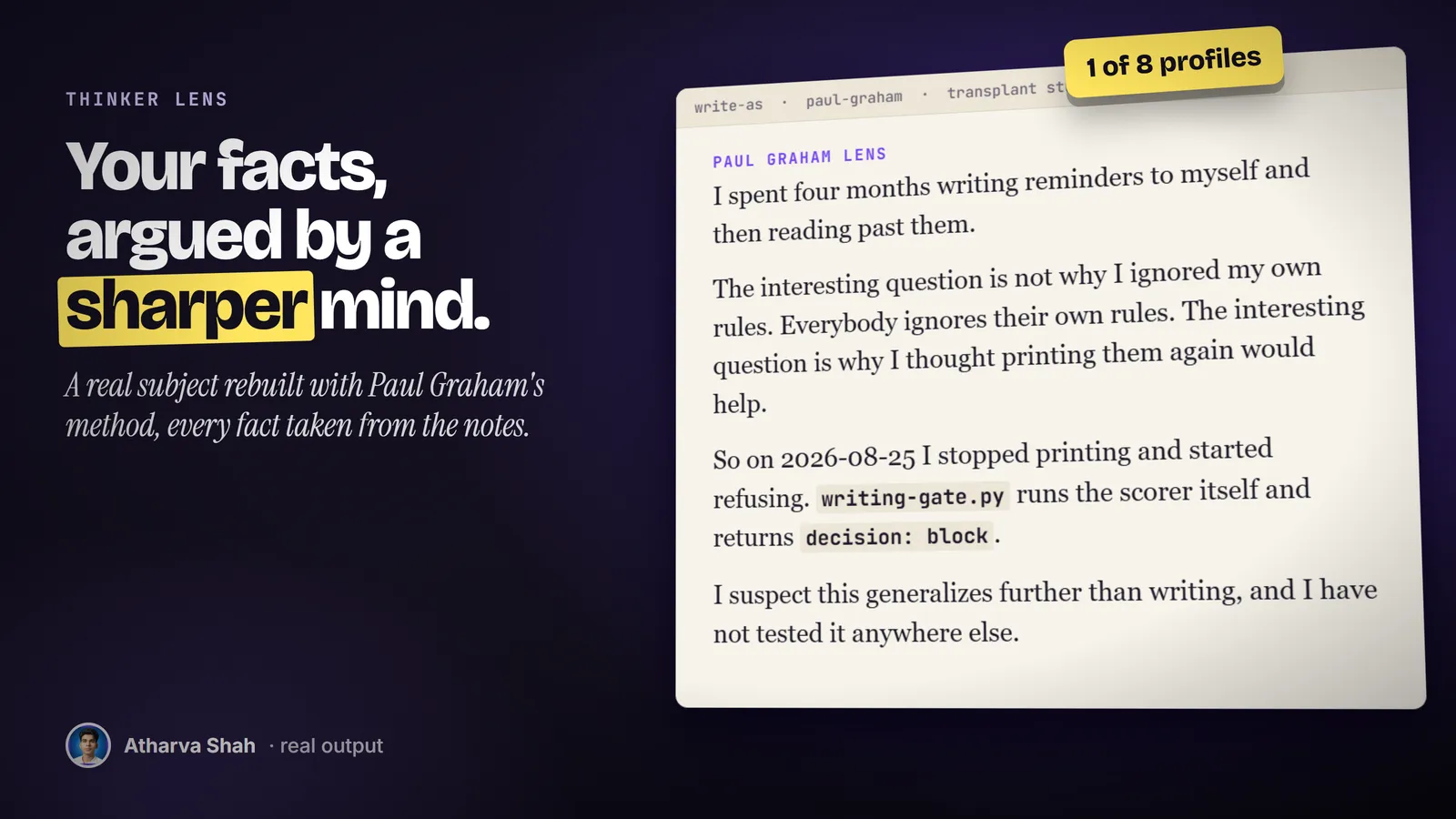
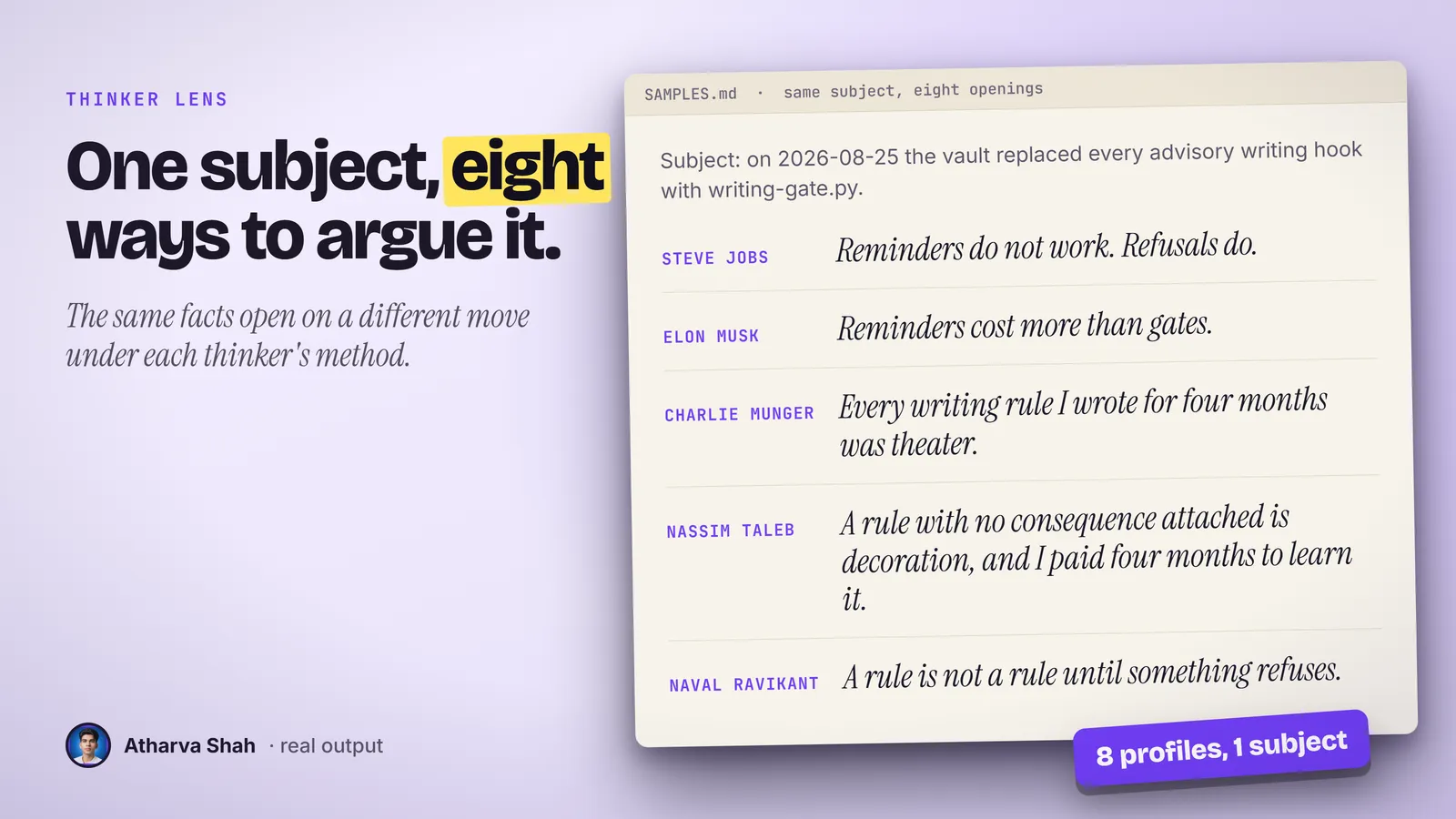
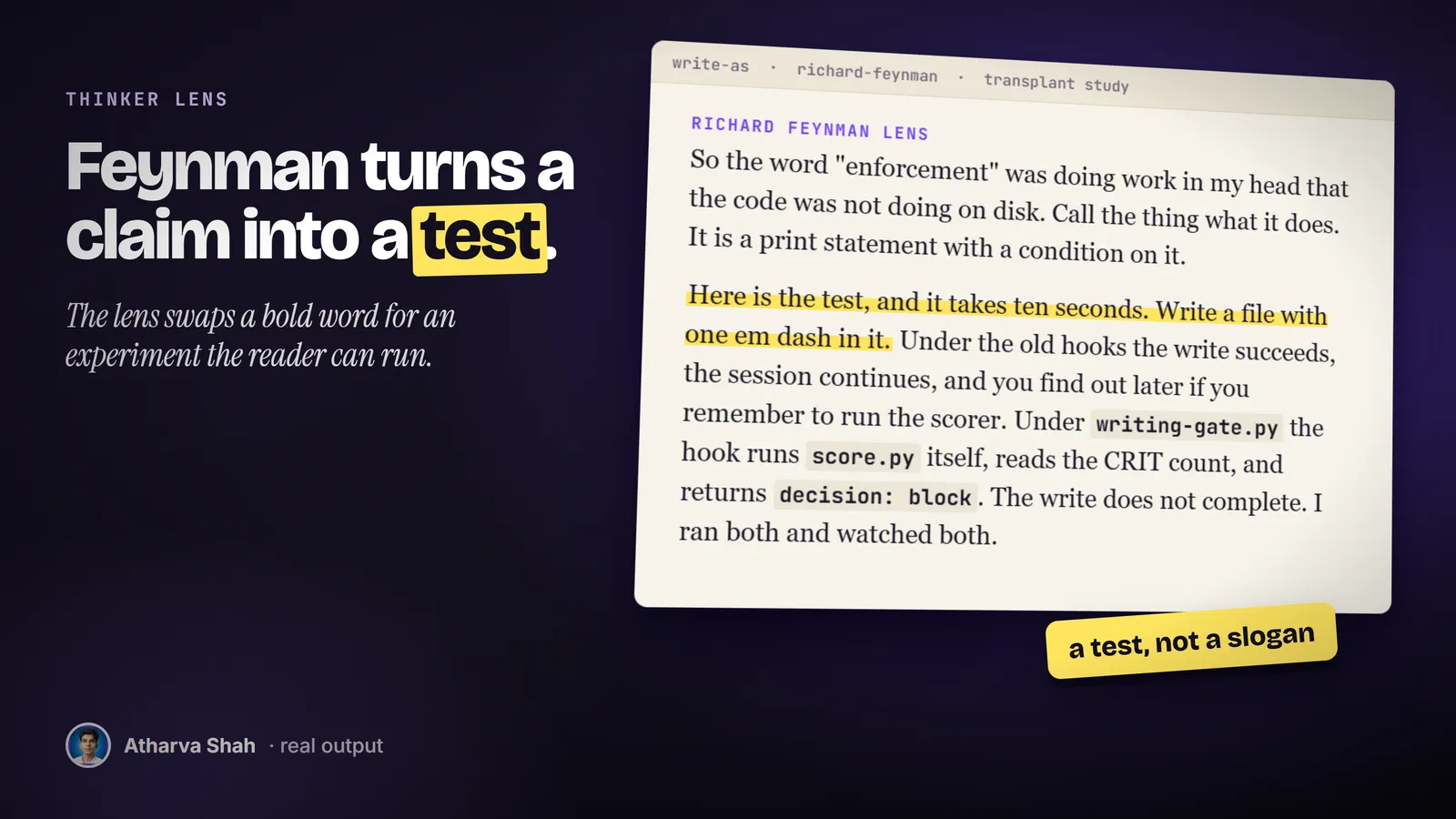
Borrow the thinking and keep your argument.
The skill borrows a method, so there is no role play and no fake quotes.
- Name the thinker. Pick one profile. It refuses to blend two, because a blend has no method and reads as generic confidence.
- It finds your claim. It writes your argument in one sentence before it changes a word. If the draft has no claim, it says so, because no lens can fix that.
- Get the rebuilt draft. The eight moves of that thinker run in order and produce a new outline, then a draft. It checks the draft against your banned-word list before you see it.
Asking a chatbot to write like someone gives you a costume.
You get the catchphrases and none of the reasoning. An editor gives you one fixed method.
Thinker Lens
- Method profiles. Each one holds mental models, eight ordered moves, and sentence mechanics.
- Your claim first. It pins your argument before it changes a sentence.
- No fabrication. A missing detail becomes a question for you.
- Two modes. Borrow the thinking only, or the thinking and the voice.
"Write like X" prompts
- Catchphrase cosplay. The output copies famous lines and skips the reasoning.
- Invented details. The model adds anecdotes and numbers to make the voice land.
- First-person impersonation. It writes as the person, which you cannot publish.
- Your argument lost. The new draft argues whatever the famous person would.
A human editor
- One method. You get their taste on every piece you send.
- Days per round. A structural edit takes a week in most queues.
- A bill per piece. The cost grows with each draft.
- Hard to compare. You cannot see three structures side by side.
The method changes. The voice stays yours by default.
Lens mode is the default. It changes the order of your ideas, the kind of evidence, and the questions the draft must answer, and it keeps your sentences. Transplant mode also borrows the sentence mechanics, and it labels the output as a study so it never enters your pipeline as your voice by accident. Each profile knows which drafts it fits, and it tells you when a lens is wrong for the piece.
Questions about Thinker Lens
Can Claude learn my writing style?
Yes. This skill keeps your facts and your voice by default and borrows only the thinker's method, such as how Feynman tests a claim or how Graham builds an argument. A second mode borrows the sentence mechanics too.
Can AI rewrite text in the style of a famous writer?
It can, and this skill does it with a written profile for each of eight thinkers, so the result follows their method rather than a loose imitation of their tone.
Will it make my post sound like Paul Graham wrote it?
Not in lens mode. It borrows his order of ideas and his standard of proof, and your sentences stay yours. Transplant mode goes further and labels the result as a study.
Does it put words in anyone's mouth?
No. It never writes as the person in first person and never invents a quote, an anecdote, or a number. A real quote is allowed once, short and attributed.
Which eight thinkers are included?
Paul Graham, Steve Jobs, Elon Musk, Charlie Munger, Richard Feynman, Nassim Taleb, Naval Ravikant, and Zhang Xuefeng.
Can I combine two thinkers?
No. One profile per run. A blend has no method, so the draft ends up confident and vague.
Can I add my own thinker?
Yes. A template shows every section a profile needs, including the part that keeps the voice legal under your own writing rules.
What if my draft has no clear argument?
It tells you before it rewrites anything. A lens reorders a claim, and it cannot supply one.
Which Claude plan do I need?
A paid plan with Claude Code. Pro is enough. Each run reads one profile and one draft.
What else do I pay for?
Nothing else. It runs on Claude and your text files.
What if the first rewrite misses?
Check the profile fit first, because each profile lists the drafts it suits. Run a different lens, or tell it which move felt wrong and it reruns that move.
Does this skill work with Gemini CLI, Codex, Cursor, or GitHub Copilot?
Yes, with one caveat. The skill is a SKILL.md folder in the Agent Skills open standard, which Claude Code, Codex CLI, Gemini CLI, Cursor, and GitHub Copilot all load. It is built and tested on Claude Code. Steps that lean on Claude-only features, such as parallel subagents, run one after another or need a manual step in other agents.
How do I install an agent skill?
Copy the skill folder into your agent's skills directory: ~/.claude/skills for Claude Code, or the skills folder your agent documents for Codex CLI, Gemini CLI, Cursor, or Copilot. The agent reads the description and loads the skill when your request matches it. Each skill ships with a setup guide for any tool it needs.
Related skills
- Deslop Audit: Scores a draft for machine tells, then reviews it, interviews you, or rewrites it clean.
- Substack Writing Harness: Triage the idea, draft the essay, and push the score to zero before you publish.
- Substack Publisher: Push, update, and publish Substack drafts and Notes from your own files, and schedule releases.
- Corpus Rule Rollout: Applies one new writing rule across hundreds of files without losing a sentence.