Short fiction that reads like someone meant every line.
Bring an image, a fear, or a half-formed idea. It builds a layered story of 1,000 to 5,000 words, then runs four critic passes before you read it.
Built by Atharva Shah. Short Story Engine costs $19, paid once. Buy Short Story Engine. The skill folder and setup guide arrive by email.
Short Story Engine at a glance
Short Story Engine is an AI agent skill for Claude Code, Codex CLI, Gemini CLI, and other agents that read SKILL.md. Layered short fiction in five veins, from psychological horror to quiet introspection. Best for: AI short story writer.
- Works with
- Claude Code, Codex CLI, Gemini CLI, Cursor, GitHub Copilot
- Category
- Writing and voice
- Price
- $19, one payment
- Requirements
- Needs a Claude plan with skills, such as Claude Code or the Claude app. Single short stories only, from 1,000 to 5,000 words, with no chapters or series.
- Included
- Five story veins, Interview and story map, Four critic passes, Revise mode
What Short Story Engine produces
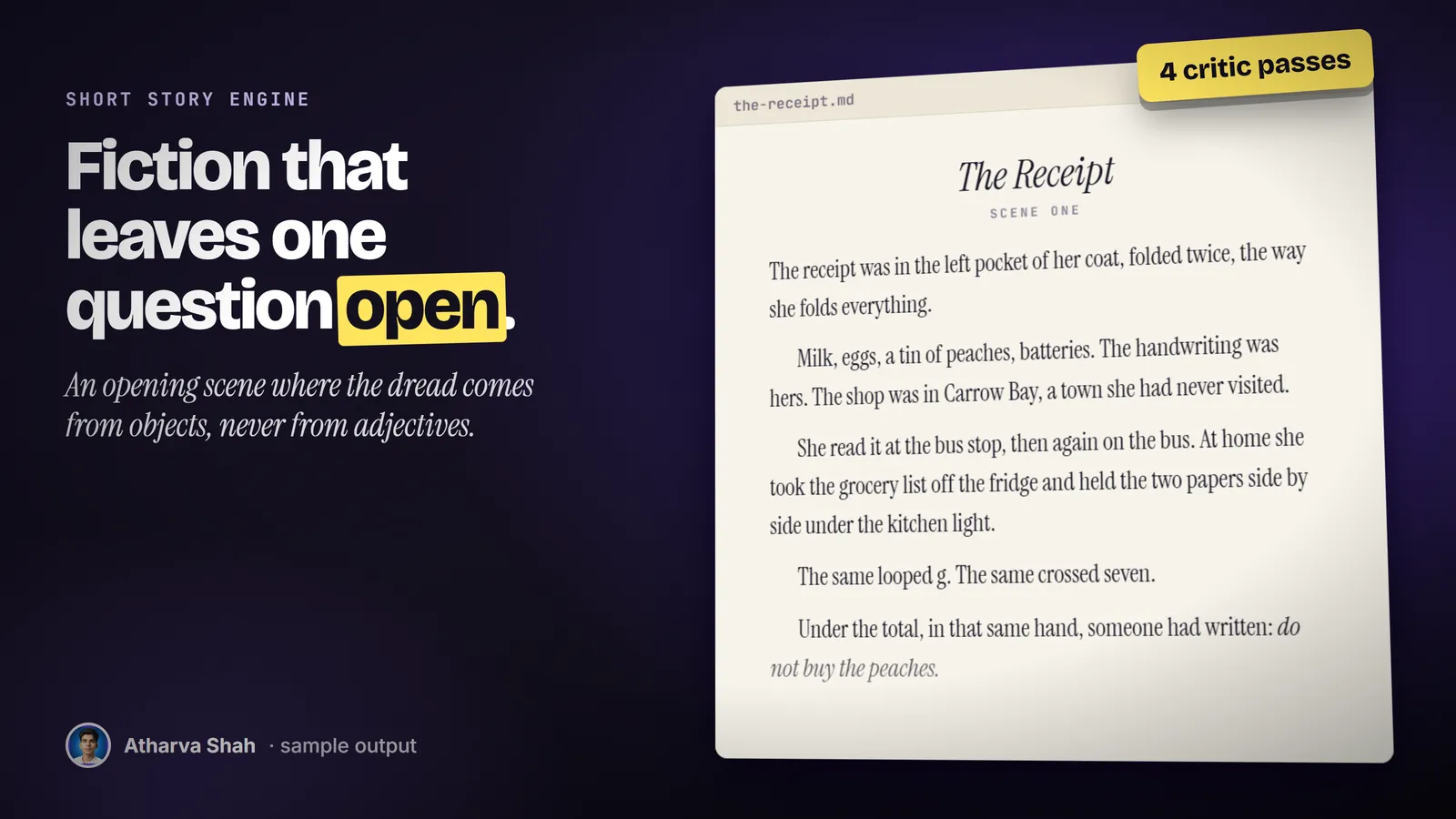
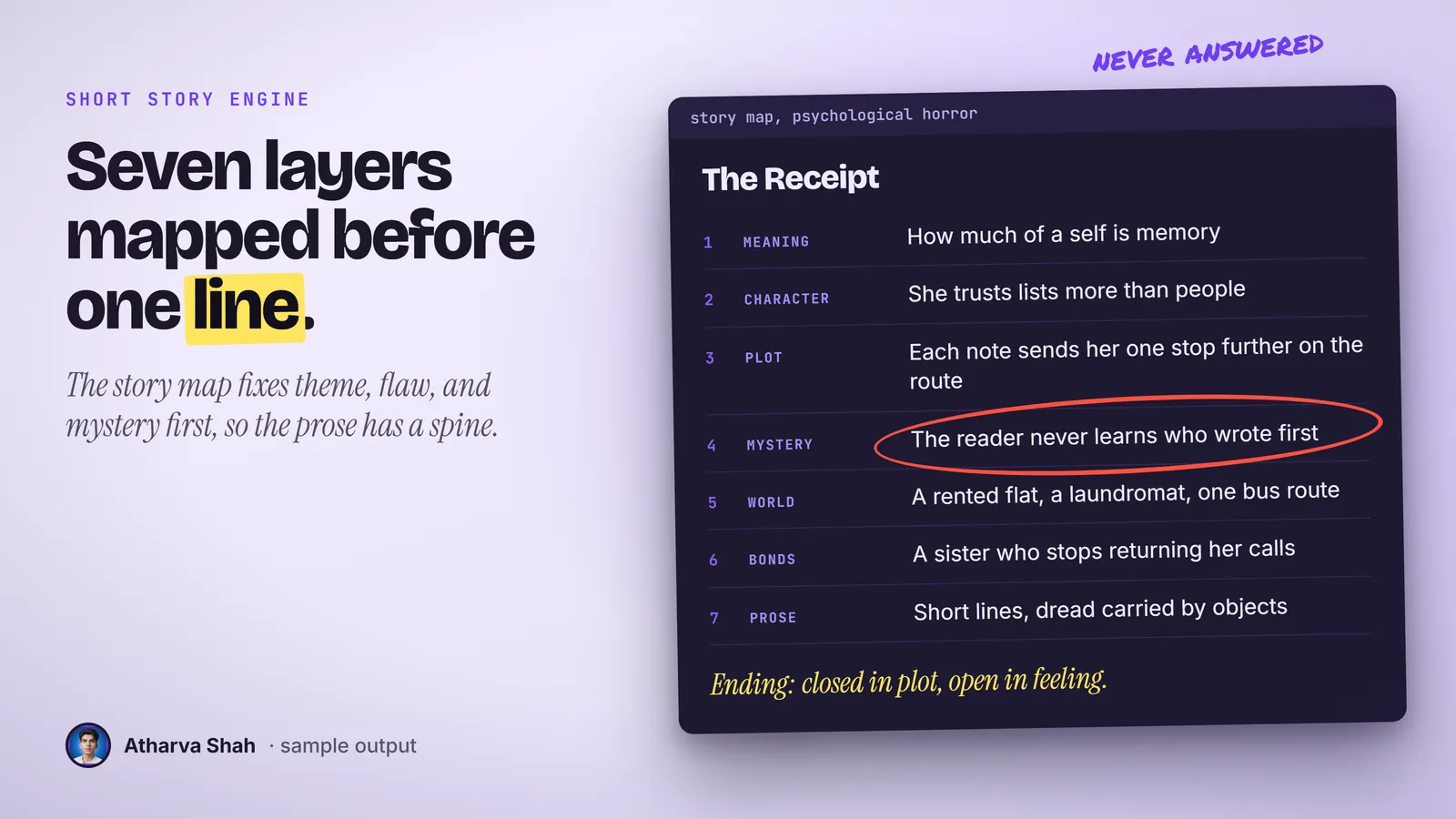
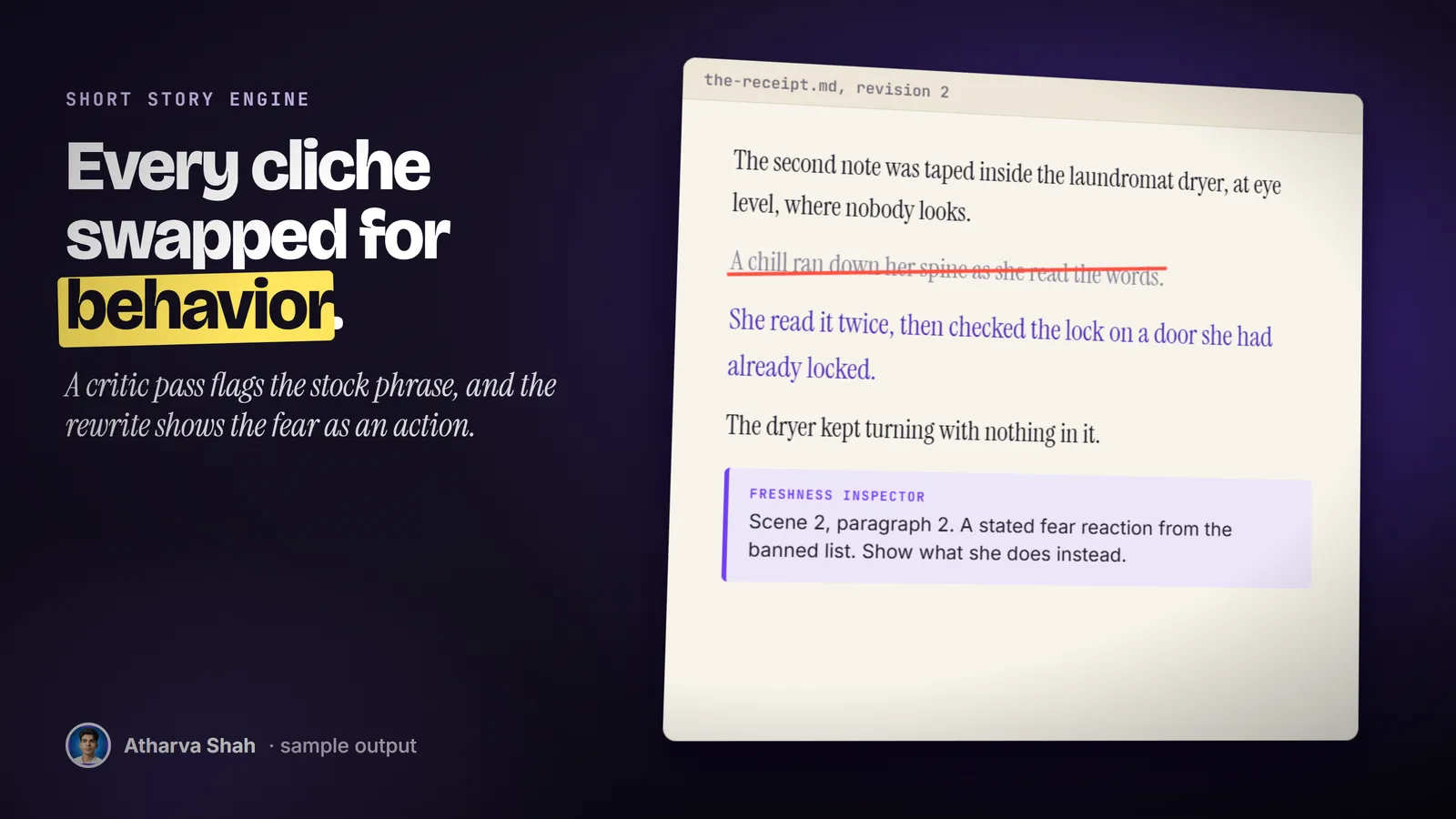
You bring the image. It builds the story around it.
Every story goes through the same three steps. You can stop and steer at each one.
- It interviews you. It pulls out the core image, the fear or feeling underneath, and the vein. It asks about your favorite stories to find the effect you want.
- It maps the story. A one-page map covers the seven layers, the scenes, and the one question the story asks and leaves open. You approve it or change it.
- It writes and critiques. It drafts the full story, sweeps it for cliches, and runs four critic passes. You get the prose, the vein, and each critic rating.
AI fiction usually reads like AI fiction.
A one-line prompt gives you stock phrases and a tidy moral. A writing course gives you theory and no draft.
Short Story Engine
- Seven layers at once. Meaning, character, plot, mystery, world, bonds, and prose.
- Four critic passes. Each critic rates one angle and names the exact lines to fix.
- A cliche sweep. Stock phrases and machine tells get replaced before you read.
- One question left open. The ending lands and still stays with the reader.
One-prompt AI stories
- A chill ran down her spine. Stock phrases in every paragraph.
- Emotions named out loud. She felt afraid, and the reader feels nothing.
- A neat bow on the end. Every mystery gets explained in the last line.
- No second pass. The first draft is the only draft.
Writing courses and books
- Theory without a draft. You learn the rules and still face a blank page.
- Months to apply. Craft habits take many stories to build.
- No feedback loop. Nobody reads your draft against the framework.
- One style taught. The teacher voice becomes your voice.
It writes toward your taste, story by story.
The default voice is atmospheric and dreamlike, in the line of Lynch and Lovecraft. You can switch it per story. Five veins cover horror, science fiction, quiet introspection, dark fantasy, and cause-and-effect stories about emotion. Name writers you love and it shapes the prose toward them. The revise mode lets you polish, deepen a layer, or rebuild the order of scenes.
Questions about Short Story Engine
Is there an AI that can write short stories?
Yes. This skill builds a complete story on seven layers at once, then runs four critic passes and a cliche sweep before you read a word.
Is it legal to publish a story written with AI?
Publishing is legal in most places. Copyright protection for AI-generated text is limited, so add your own edits and check the rules of any platform or contest first.
What length does it write?
One complete short story from 1,000 to 5,000 words. It does not write novels, chapters, or series.
Which genres does it cover?
Five veins: horror and psychological thriller, science fiction, introspection and daydream, fantasy, and emotional cause-and-effect stories. You can blend two.
Do I have to use the dark, dreamlike voice?
No. It is the default. Name a different voice or writers you love, and it shapes the prose toward them.
Can I start with just one image?
Yes. The interview turns a single image or feeling into a story map before any prose gets written.
Can it revise a story I wrote?
Yes. Revise mode polishes prose, deepens thin layers, fixes dialogue voice, sweeps for cliches, or reorders scenes.
Which Claude plan do I need?
A paid plan that runs skills. Pro is enough. A 5,000-word story with four critic passes uses a large share of one session.
What else do I pay for?
Nothing. It needs no API keys or extra tools.
What if the first story falls flat?
Read the critic ratings and pick the weakest angle. Ask it to revise that layer. A sharper image and a clear feeling in the interview give a stronger first draft.
Does this skill work with Gemini CLI, Codex, Cursor, or GitHub Copilot?
Yes, with one caveat. The skill is a SKILL.md folder in the Agent Skills open standard, which Claude Code, Codex CLI, Gemini CLI, Cursor, and GitHub Copilot all load. It is built and tested on Claude Code. Steps that lean on Claude-only features, such as parallel subagents, run one after another or need a manual step in other agents.
How do I install an agent skill?
Copy the skill folder into your agent's skills directory: ~/.claude/skills for Claude Code, or the skills folder your agent documents for Codex CLI, Gemini CLI, Cursor, or Copilot. The agent reads the description and loads the skill when your request matches it. Each skill ships with a setup guide for any tool it needs.
Related skills
- Deslop Audit: Scores a draft for machine tells, then reviews it, interviews you, or rewrites it clean.
- Thinker Lens: Rewrites your piece through the method of Graham, Munger, Feynman, and five more.
- Substack Writing Harness: Triage the idea, draft the essay, and push the score to zero before you publish.
- Substack Publisher: Push, update, and publish Substack drafts and Notes from your own files, and schedule releases.